

J.S. BACH’S CANTATA 1
Virtual Performance Content
Wie schon leuchtet der Morgenstern (How beautifully shines the morning star) is one of J. S. Bach’s most memorable works. If only for the choral fantasia that opens the score, the cantata would be forever enshrined. Comprised of six movements, the first chorus is succeeded by two arias, each preceded by a recitative. The work’s destiny is seemingly the ending chorale, and if the description is correct, the design is curious: the variations have come before the theme. Be that as it may, the first performance took place at Thomaskirche in Leipzig on Palm Sunday, March 25, 1725. The identity of Bach’s librettist is not known, but the unidentified poet paraphrased the original for the work’s two recitatives and arias. Otherwise, the writer used Philipp Nicolai’s hymn, which dates back to 1599. The cantata’s scoring is rousing and communal.
Wie schon leuchtet der Morgenstern is not the first cantata written by Bach. It survives as the last of his second cantata cycle for Thomaskirche , a collection distinguished by its incorporation of chorales and paraphrases of their texts. Complicating matters is the composer’s practice of treating the first Sunday after Trinity and not Advent as the beginning the church year.
The autograph to the cantata has been lost. What we have today is reconstructed from surviving vocal and instrumental parts. Wie schon leuchtet der Morgenstern achieved such fame that a century after Bach’s death in 1750 it became known as the first of Bach’s many works, and the name stuck. Some proof of this can be seen in the Neue Bach-Ausgabe of 1995 where the 19th century practice was continued (Bach Werke Verzeichnis 1 or BWV 1).
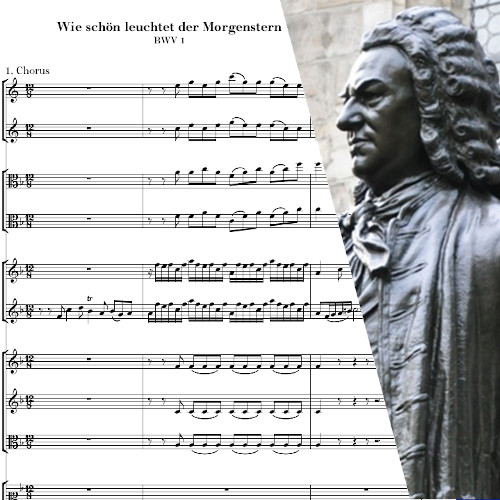
Wie schon leuchtet der Morgenstern’s layout consists of a choral fantasia beginning, the sopranos towering above the whole by singing the chorale tune in long tones. Two recitatives and two arias follow. The last named are concertante pieces by which is meant they include obbligato instruments that ‘compete’ with the soloist. There is no recitative before the ending chorale, which contains an independent horn part cutting through a straight-forward chordal texture.